
In the rapidly evolving field of artificial intelligence (AI), foundation models have emerged as a critical element for various applications. Foundation models are large-scale language models trained on vast amounts of data, capable of understanding and generating human-like text. They serve as a starting point or foundation for building more specific and task-oriented AI models. Here are the key points explaining what foundation models are and why they are essential:
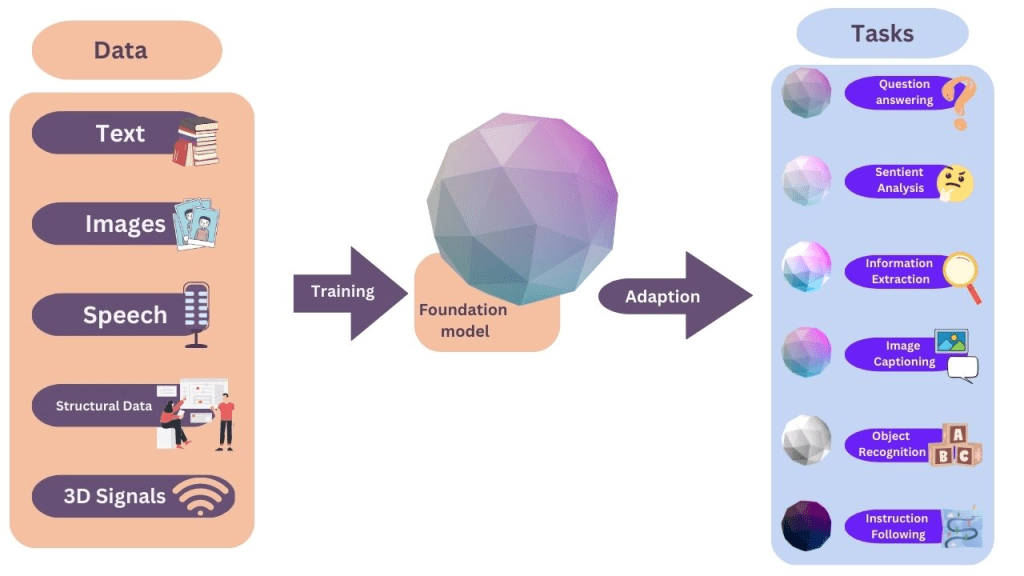
- Definition and Function: Foundation models are pre-trained AI models that have learned from vast amounts of text data. They are designed to understand and generate human-like text by predicting the next word in a sequence given a context. These models use a technique called unsupervised learning, where they learn from the patterns and structures in the data without explicit instructions. The goal of foundation models is to capture the general knowledge and linguistic patterns present in the data.
- Vast Knowledge Base: Foundation models are trained on massive datasets, often consisting of billions or even trillions of words. This extensive training allows them to acquire a vast knowledge base that spans various domains and topics. As a result, they can generate coherent and contextually relevant responses for a wide range of queries and tasks.
- Transfer Learning: One of the primary benefits of foundation models is their ability to perform transfer learning. After the initial pre-training phase, these models can be fine-tuned on specific tasks or domains using a smaller dataset. This transfer learning approach saves computational resources and time by leveraging the knowledge learned during pre-training. It enables developers to build task-specific models more efficiently and effectively.
- Versatility and Adaptability: Foundation models are designed to be versatile and adaptable to different domains and applications. They can be used for various natural language processing tasks, including language translation, sentiment analysis, question-answering, and more. By fine-tuning the pre-trained models, developers can tailor them to specific tasks, enabling them to solve complex problems across different industries.
- Enhanced Performance: Foundation models have significantly advanced the performance of AI systems in natural language understanding and generation tasks. Their extensive pre-training allows them to grasp the nuances of language, understand context, and generate coherent and contextually relevant responses. Compared to traditional rule-based or statistical models, foundation models have demonstrated superior performance across multiple benchmarks.
- Accessibility and Democratization: Foundation models have paved the way for democratizing AI technologies. Open-source implementations like GPT (Generative Pre-trained Transformer) have made these models widely accessible to researchers and developers worldwide. This accessibility fosters innovation, collaboration, and the development of novel applications by a broader community.
- Ethical Considerations: While foundation models have tremendous potential, they also raise important ethical considerations. The models learn from the vast amount of data available on the internet, which may include biased or offensive content. Consequently, there is a need for responsible development and fine-tuning to mitigate biases and ensure fair and unbiased outcomes.
- Continuous Improvement: Foundation models continue to evolve and improve over time. Researchers and developers are constantly refining the training methodologies and fine-tuning techniques to enhance the models’ performance and mitigate limitations. This iterative process enables the development of even more powerful and accurate AI systems.
In conclusion, foundation models have emerged as a crucial component in the AI landscape. Their vast knowledge base, versatility, and ability to perform transfer learning have revolutionized the field of natural language processing. By providing a foundation for building task-specific models, they enhance performance, accessibility, and foster innovation. However, it is vital to address ethical concerns and continually improve these models to ensure responsible and unbiased AI applications.
To Learn More:- https://www.leewayhertz.com/foundation-models/
 Jasper's financial blog