
Generative Artificial Intelligence (AI) has emerged as a powerful tool in the field of healthcare, transforming the way we diagnose, treat, and manage diseases. By leveraging the capabilities of machine learning and neural networks, generative AI has the potential to revolutionize healthcare and improve patient outcomes. Here are 10 ways in which generative AI is making a significant impact in healthcare:
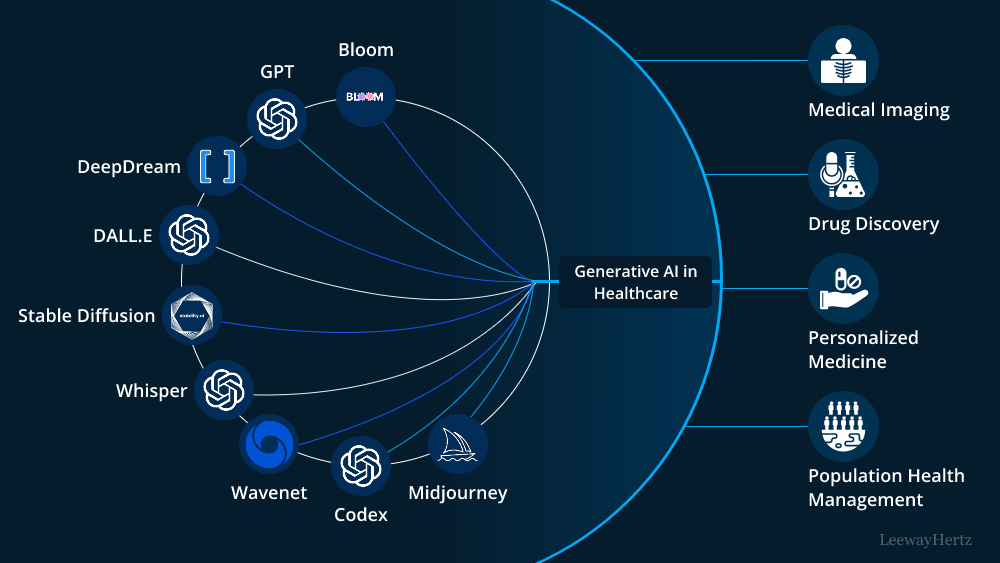
- Disease Diagnosis: Generative AI can analyze vast amounts of medical data, including images, lab results, and patient records, to assist in the diagnosis of diseases. By identifying patterns and anomalies, generative AI algorithms can help healthcare professionals make more accurate and timely diagnoses, leading to improved treatment outcomes.
- Medical Imaging: Interpreting medical images is a complex task that often requires expertise and time. Generative AI algorithms can analyze medical images such as X-rays, MRIs, and CT scans, helping radiologists detect abnormalities and early signs of diseases. This technology enables faster and more accurate diagnoses, leading to timely interventions.
- Drug Discovery: Developing new drugs is a time-consuming and costly process. Generative AI algorithms can expedite the drug discovery process by analyzing vast amounts of chemical and biological data, identifying potential drug candidates, and predicting their efficacy and safety profiles. This can significantly accelerate the development of new treatments and therapies.
- Personalized Medicine: Generative AI can analyze individual patient data, including genetic information, medical history, and lifestyle factors, to develop personalized treatment plans. By considering a patient’s unique characteristics, generative AI algorithms can optimize treatment outcomes and minimize adverse effects.
- Virtual Assistants: Generative AI-powered virtual assistants can help patients and healthcare professionals by providing personalized recommendations, answering health-related questions, and offering reminders for medication adherence and appointments. These virtual assistants can enhance patient engagement, improve communication, and streamline healthcare delivery.
- Prognostic Models: Generative AI can leverage predictive modeling techniques to estimate patient outcomes and disease progression. By analyzing patient data and clinical variables, generative AI algorithms can generate accurate prognostic models that assist healthcare professionals in making informed decisions about treatment plans and interventions.
- Medical Education and Training: Generative AI can be used as a valuable tool in medical education and training. Simulations and virtual patient scenarios powered by generative AI can help medical students and healthcare professionals practice their skills, enhance diagnostic capabilities, and learn complex procedures in a safe and controlled environment.
- Clinical Decision Support Systems: Generative AI algorithms can be integrated into clinical decision support systems, providing healthcare professionals with evidence-based recommendations and treatment guidelines. By considering a wide range of patient data and medical literature, these systems can assist in the decision-making process, leading to more standardized and effective care.
- Predictive Maintenance: Generative AI algorithms can be applied to medical equipment and devices to predict maintenance needs and prevent potential failures. By analyzing data from sensors and monitoring systems, generative AI can identify patterns and anomalies that indicate the need for maintenance or replacement, ensuring the reliability and availability of critical healthcare infrastructure.
- Mental Health Support: Generative AI-powered chatbots and virtual assistants can provide mental health support to individuals, offering counseling, monitoring emotional well-being, and providing resources for self-help. These tools can help bridge the gap in mental health services and provide accessible support to those in need.
Generative AI has tremendous potential to transform healthcare by improving diagnosis accuracy, accelerating drug discovery, enabling personalized treatments, and enhancing patient care. While there are challenges and ethical considerations to address, the integration of generative AI into healthcare systems holds the promise of a future where technology plays a crucial role in improving health outcomes and transforming the patient experience. As research and development in this field continue to advance, we can expect even more innovative applications of generative AI in healthcare, leading to a more efficient and patient-centered healthcare system.
To Learn More:- https://www.leewayhertz.com/generative-ai-in-healthcare
 Jasper's financial blog