
The rapid advancements in Artificial Intelligence (AI) have sparked a revolution in the healthcare industry. One of the most promising and transformative applications of AI in healthcare is Generative AI, which involves using algorithms to generate new data, images, or even human-like text based on patterns learned from existing data. The potential of Generative AI is vast, with various applications that can significantly impact patient care, disease diagnosis, drug discovery, and more. In this article, we will explore ten compelling use cases of Generative AI in healthcare.
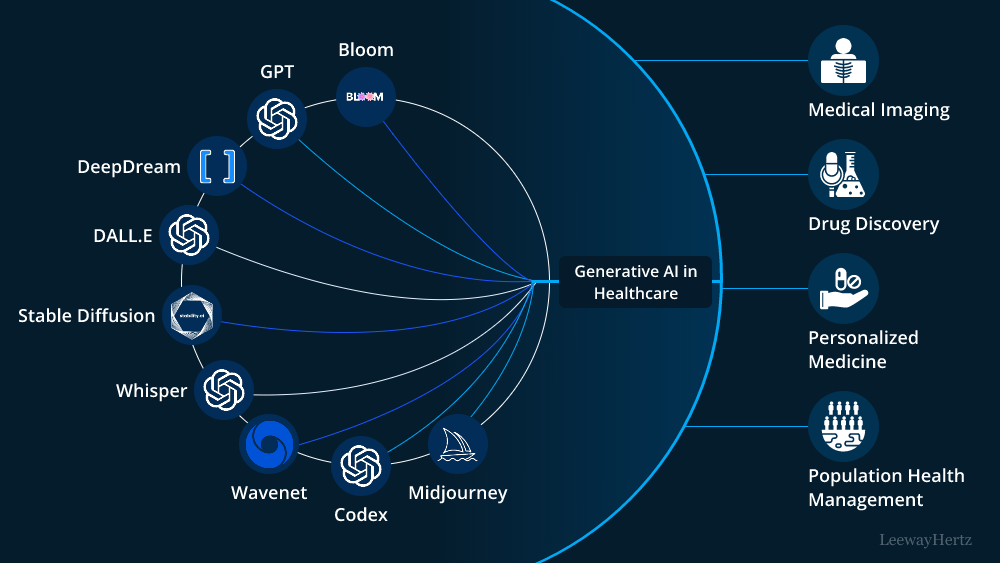
- Medical Image Generation
Generative AI models, such as Generative Adversarial Networks (GANs), have shown great promise in generating high-quality medical images. These models can synthesize realistic images of organs, tissues, and even anomalies, helping medical professionals enhance their understanding of complex medical conditions and aiding in surgical planning and medical training.
- Drug Discovery
The drug discovery process is often expensive and time-consuming. Generative AI can significantly accelerate this process by designing novel drug compounds based on vast datasets. These AI models can predict the chemical structures of potential drugs with desirable properties, enabling researchers to identify potential candidates more efficiently.
- Disease Diagnosis and Prediction
Generative AI algorithms can analyze patient data and generate predictive models for various diseases, such as cancer, diabetes, and cardiovascular conditions. These models can assist healthcare professionals in early detection, accurate diagnosis, and personalized treatment planning, leading to better patient outcomes.
- Medical Data Augmentation
To train robust AI models, a significant amount of labeled data is required. Generative AI can help augment the available data by generating synthetic samples, thereby improving the performance of AI models in various medical applications, including image analysis, natural language processing, and clinical decision support systems.
- Personalized Treatment Plans
Every patient’s response to treatment can vary due to individual genetic makeup and other factors. Generative AI can leverage patient data to generate personalized treatment plans, suggesting the most suitable therapies and dosages for individual patients, leading to more effective and tailored care.
- Electronic Health Record (EHR) Generation
In some cases, medical data may be incomplete or unavailable due to privacy concerns or other limitations. Generative AI can help by generating synthetic electronic health records that mimic real patient data while preserving anonymity, facilitating medical research without compromising patient privacy.
- Mental Health Support
Generative AI-powered chatbots and virtual assistants can be designed to interact with patients, providing mental health support and assistance. These AI companions can engage in conversations, offer emotional support, and direct individuals towards appropriate resources when needed, easing the burden on mental health professionals and improving accessibility to mental healthcare.
- Speech and Language Generation
Generative AI can be used to create synthetic speech and language models. These models can be utilized to generate natural-sounding speech for patients with speech impairments, assistive devices for individuals with communication difficulties, or even generate medical documentation from spoken input, reducing administrative burdens for healthcare providers.
- Medical Simulation and Training
Medical professionals often require extensive training and practice before performing complex procedures. Generative AI can create realistic medical simulations, allowing healthcare students and practitioners to practice surgeries, medical interventions, and emergency scenarios in a safe and controlled environment.
- Drug Adverse Event Simulation
Generative AI models can simulate the effects of drugs on a virtual population, predicting potential adverse reactions and interactions before actual clinical trials. This can help in designing safer medications and minimizing risks associated with new drug treatments.
Conclusion
Generative AI has emerged as a powerful tool in healthcare, revolutionizing various aspects of medical research, diagnosis, and patient care. The ten use cases discussed above highlight the potential of Generative AI to transform the healthcare landscape, enabling more precise diagnostics, personalized treatments, and streamlined drug discovery processes. As this technology continues to evolve, its integration into healthcare systems can significantly enhance medical outcomes and improve the overall well-being of patients worldwide. However, it is essential to ensure responsible AI development, ethical use, and proper regulation to maximize the benefits while minimizing potential risks.
To Learn More:- https://www.leewayhertz.com/generative-ai-in-healthcare/
 Jasper's financial blog