
In today’s data-rich landscape, the convergence of AI Consulting Company and data integration has revolutionized how organizations manage, unify, and derive insights from disparate data sources. AI-driven data integration techniques have emerged as a powerful force, enabling seamless integration, intelligent processing, and enhanced decision-making capabilities. This comprehensive guide navigates through the key techniques employed in AI-driven data integration, exploring their significance, methodologies, and transformative impact on businesses.
1. Machine Learning-Assisted Mapping
Traditional data integration involves manual mapping of data fields between disparate sources, which can be time-consuming and error-prone. Machine learning (ML) algorithms, however, automate this process by analyzing data patterns, similarities, and semantics to map and align data fields accurately. ML models learn from historical mappings and adapt to evolving data structures, expediting the integration process and ensuring accuracy.
2. Natural Language Processing (NLP) for Data Harmonization
NLP techniques facilitate the harmonization of data from different sources by understanding and processing unstructured or semi-structured data formats, such as text or documents. NLP algorithms extract valuable information, identify entities, and normalize data, enabling the integration of diverse data types, including text-based information from sources like emails, reports, or social media.
3. Intelligent Data Matching and Deduplication
AI-powered algorithms utilize advanced matching techniques, such as fuzzy matching or probabilistic record linkage, to identify and merge similar or duplicate records across disparate datasets. By employing probabilistic models, AI-driven systems can identify matching records even in cases of incomplete or inconsistent data, ensuring data quality and eliminating redundancies.
4. Automated Data Cleansing and Enrichment
AI-driven data integration platforms leverage algorithms to automate data cleansing tasks by detecting and rectifying inconsistencies, errors, or missing values within datasets. Furthermore, these platforms utilize external data sources and APIs to enrich existing data with additional attributes or information, enhancing the overall quality and completeness of integrated datasets.
5. Predictive Analytics for Data Preprocessing
Predictive analytics techniques aid in preprocessing and transforming data before integration by identifying trends, anomalies, or outliers within datasets. These insights help in structuring data, identifying relevant features, and preparing datasets for integration, thereby enhancing the accuracy and reliability of integrated data.
6. Semantic Data Integration and Knowledge Graphs
Semantic data integration employs ontologies and knowledge graphs to establish relationships and semantic meaning between disparate datasets. By utilizing linked data principles and semantic modeling, AI-driven systems create a unified representation of data, enabling more contextually rich and meaningful integration, which goes beyond traditional relational connections.
7. Continuous Learning and Adaptive Integration
AI-driven data integration systems are designed to continuously learn and adapt to evolving data structures, schemas, or sources. Through reinforcement learning or adaptive algorithms, these systems optimize integration processes over time, accommodating changes in data patterns, formats, or sources, ensuring ongoing accuracy and relevance.
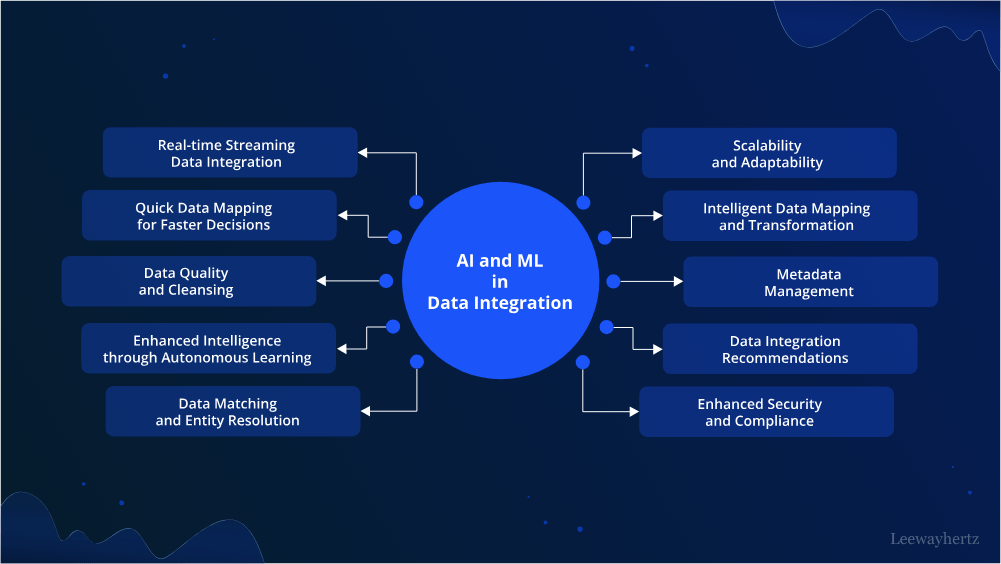
Choosing the Right AI-Driven Data Integration Techniques
- Data Complexity and Diversity: Evaluate the diversity and complexity of data sources—structured, unstructured, semi-structured—to determine techniques suitable for handling various data types.
- Integration Objectives: Align integration strategies with specific business objectives—whether it’s improving data quality, enhancing analytics, or enabling real-time insights.
- Technical Infrastructure: Assess the existing technology stack and infrastructure capabilities to determine compatibility and support for AI-driven integration techniques.
- Regulatory Compliance and Data Governance: Ensure that AI-driven integration techniques comply with regulatory standards and data governance policies to maintain data privacy and security.
The Impact of AI-Driven Data Integration
- Enhanced Data Accuracy and Quality: AI techniques mitigate errors, inconsistencies, and duplications, ensuring high-quality integrated data.
- Accelerated Integration Processes: Automation and intelligent mapping speed up integration, reducing manual efforts and time required for data processing.
- Improved Decision-Making: Access to accurate, unified, and real-time data empowers organizations to make informed decisions swiftly, driving innovation and efficiency.
- Adaptability and Future Readiness: AI-driven systems adapt to evolving data landscapes, ensuring ongoing relevance and adaptability to changes in data sources or structures.
Conclusion
AI-driven data integration techniques stand at the forefront of innovation, reshaping how organizations manage and utilize data. By harnessing the power of machine learning, natural language processing, predictive analytics, and semantic modeling, these techniques enable organizations to unlock the true potential of disparate data sources.
As businesses increasingly rely on data as a strategic asset, the strategic adoption of AI-driven data integration techniques becomes pivotal. Embracing these techniques empowers organizations to navigate the complexities of data integration, drive actionable insights, and pave the way for a future defined by data-driven decision-making and innovation.
 Jasper's financial blog